


Diamond Mining and Sources
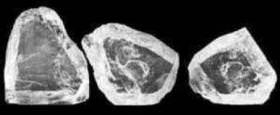
Diamonds are stunning, mysterious and rare. They reach us after a long journey starting deep down in the earth as carbon put under enormous pressure and temperature. Molten rock called magma carry them to the surface and they are found within tubes or pipes as they are known of volcanic rock, in this instance named kimberlite. Sometimes these are worn away by weathering and the diamonds will reappear within alluvial deposits at times a great distance from their original source. Diamond production has grown over the last one hundred and fifty years, nevertheless the gem is still a rare commodity. Diamond producing countries include Botswana, Canada, Namibia, Russia, South Africa, Australia, and Tanzania. Diamonds that come from the volcanic pipes require open pit or underground mining operations whilst those found in alluvial deposits employ different techniques that uncover diamonds in riverbed and marine locations. In either instance enormous investment and skill is required. By Moti Israeli More on this subject: Israel Diamond Exchange Diamond Certificates Diamond Knowledge
Manufacturing and Cutting
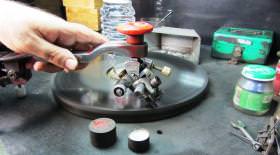
Once mined, rough diamonds are sorted into industrial diamonds or those of gem quality. Those of gem quality are classified into groups based on size, shape, quality and color. Every diamond has some unique feature so as no two diamonds are the same. After sorting, the diamonds are cut and polished requiring great skill and experience. Belgium, China, India, Israel, Russia and the USA as well as other countries have centres for facilitating this. The more proficiently a stone is cut the more reflected light and brilliance will be seen. The diamond after this process is classified by its cut, color, clarity and carat weight, known famously as the “Four Cs.” By Moti Israeli More on this subject: Israel Diamond Exchange Diamond Certificates Diamond Knowledge
Diamond Types and Grades
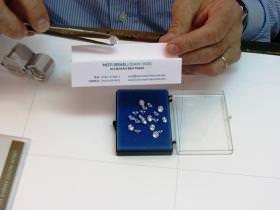
Cut: The art of polishing a diamond is to maximize its brilliance and fire (dispersion). A diamond that is cut too deep or too shallow will be less brilliant and ultimately, less valuable. The cut is the only factor of a polished diamond’s value that is controlled by human hands. Colour: The smallest variation in colour makes a difference. Colourless diamonds are the most admired, but diamonds are found in all colours of the rainbow. The rarer the colour, the more valuable is the diamond. Clarity: Most diamonds contain inclusions, which developed during their formation in the earth. The number, type, size, position and brightness of these inclusions can affect the clarity of a diamond. Carat: The weight, which will reflect its size, of a diamond is expressed in carats.Five carats is equivalent to 1gram and is divided into 100 ‘points’. By Moti Israeli More on this subject: Israel Diamond Exchange Diamond Certificates Diamond Knowledge
Marketing and Famous Stones
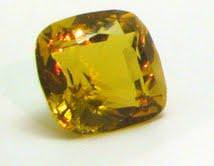
Some of the most celebrated diamonds include:The Cullinan: Found in South Africa in 1905, it was the world’s largest gem-quality diamond, weighing 3,105 carats uncut. The Tiffany: Discovered in the Kimberley Mine around 1877, this 287.42-carat diamond was turned into a 128.54-carat yellow cushion cut with 90 facets. The Golden Jubilee: Unearthed at the Cullinan mine in South Africa in1985, this 755.5 carat fancy yellow-brown diamond is now the largest cut diamond in the world, weighing 545.07 carats. The Jonker Diamond: At the time of its discovery in 1934, this 725 carat diamond was the fourth largest gem-quality diamond ever found. In 1977, it was sold for a reported $2,259,400. The Koh-i-Noor: Meaning the “Mountain of Light” in Persian, is a 105.6 carat diamond, and once the largest known diamond. The Koh-i Noor is believed by some to have originated in the state of Andhra Pradesh in India together with its double, the Darya-ye Noor (the “Sea of Light”). The diamond has belonged to various Hindu, Iranian, Afghan, Sikh and British rulers who fought bitterly over it, consequently taking it as a spoil of war. Recently the British East India Company took possession from Duleep Singh in 1850 and presented to Queen Victoria it became part of the British Crown Jewels when she was proclaimed Empress of India in 1877. It was set in the crown of the consort of the reigning monarch, was worn by Queen Alexandra, later by Queen Mary and most recently by Queen Elizabeth the mother of the present Queen and is on display at the Tower of London Whatever the size or quality, a diamond is a symbol of love, an expression of one’s inner emotions in every language, a gift for any occasion, and an item of international value to be treasured and passed on from generation to generation. By Moti Israeli More on this subject: Israel Diamond Exchange Diamond Certificates Diamond Knowledge